How Small Rooms Feel Spacious — 7 Design Principles from Practice
Small rooms have untapped potential that most people underestimate. With the right design decisions, even an 18 m² room can feel airy, generous and personal.
Alla Tatarchuk
Alla Tatarchuk ist Interior Designerin in Berlin. Seit 2017 gestaltet sie Wohn-...
Anyone living in Berlin knows the challenge: apartments are expensive and rooms are often small. But size is not a question of square metres — it is a question of design.
After years of working with Berlin's old buildings and modern city apartments, I have developed seven principles that I return to again and again when the task is to make a little feel like a lot.
#1. Light is space
No material creates more depth than natural light. Bright, reflective surfaces — light-coloured walls, polished concrete, lacquered furniture in cream or white — multiply the incoming light and let the room expand in every direction.
One key detail: curtains should hang beside the window, not in front of it. The curtain rail should start 20–30 cm above the window frame and extend to the ceiling. The room immediately feels taller.
#2. Fewer pieces, more presence
A common mistake: too many small furniture pieces. They visually fragment the room. It is far better to choose fewer, more considered pieces that make a statement.
A large sofa in a small living room often feels more elegant than three smaller seats. It gives the room a clear focal point — and the occupant a sense of generosity.
#3. Use vertical lines
Human perception follows lines. Vertical stripes on the wall, tall shelving, curtains reaching to the ceiling — all of this draws the eye upward and suggests height.
In a Berlin Altbau with three-metre ceilings, this works beautifully: a floor-to-ceiling bookcase becomes part of the architecture of the room.
#4. A clear colour palette
Three colours are enough. A small room with too many different colours and patterns feels restless and smaller than it is. A coherent palette — cream, olive green and natural wood, for example — creates harmony and openness.
This does not mean the room has to be boring. Contrasts can be used sparingly: a dark cushion, a coloured ceramic pot, a single accent wall.
#5. Furniture on legs, not on the floor
Sofas, beds and sideboards that sit flush to the floor make a room feel heavier. Furniture on visible legs lifts the eye away from the floor — the room seems to float.
A simple swap: exchange the old sofa bed on castors for a model on slim wooden legs. The difference is immediately felt.
#6. Use mirrors strategically
A mirror opposite a window doubles the light and makes the room appear deeper. Not as a decorative element, but as an architectural tool.
The mirror needs to be large enough to actually work — at least 60 × 90 cm. Small decorative mirrors barely fulfil this purpose.
#7. Multi-functional furniture without compromise
In small rooms, every piece of furniture needs to serve several purposes. But multi-functionality must not come at the cost of aesthetics.
A fold-out dining table that is used every day must look beautiful — even when folded away. A bed with storage underneath needs an elegant base panel. The compromise happens in the material and the craftsmanship, not in the form.
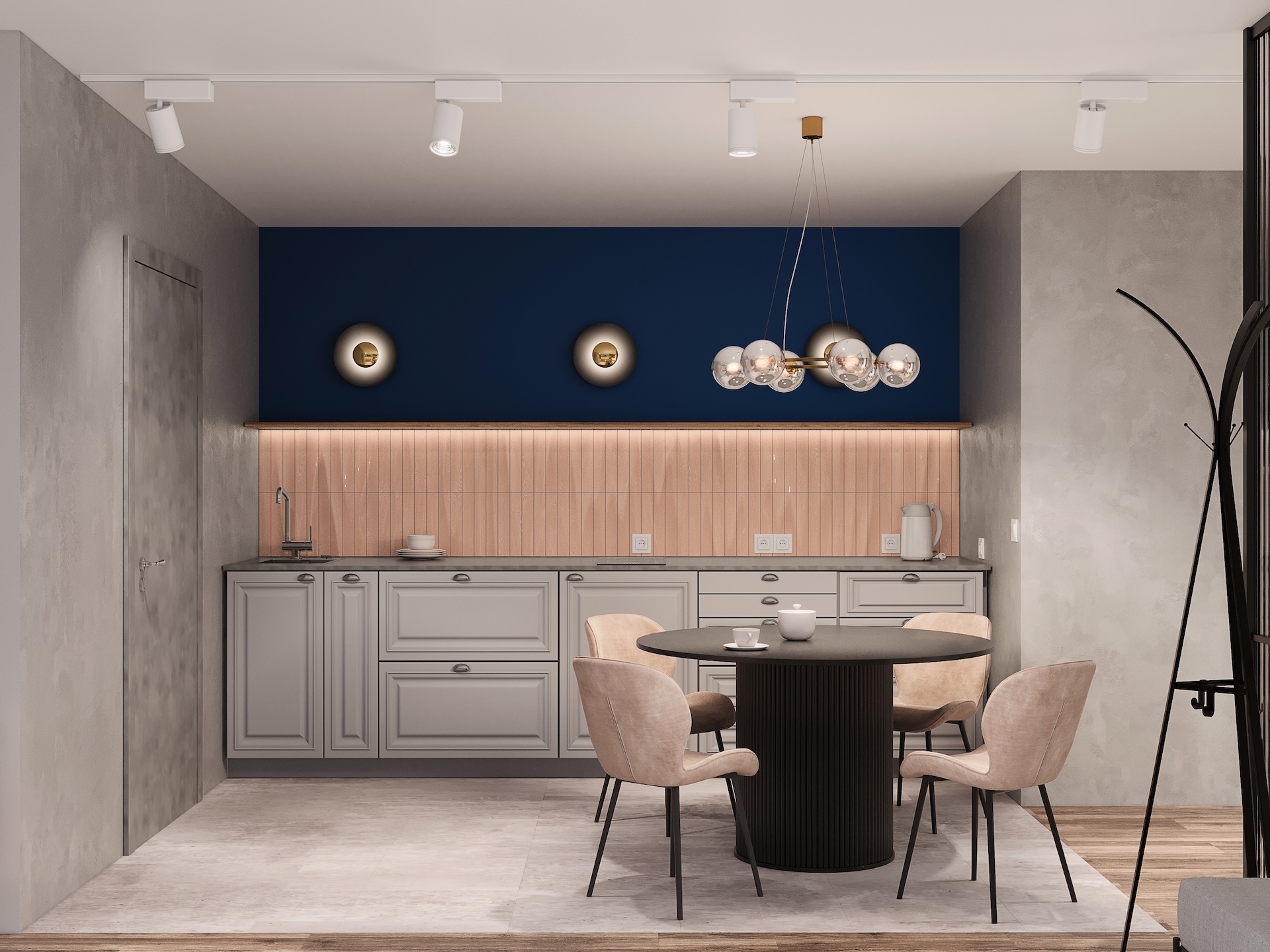
What it looks like when all seven principles work together: in this kitchen-living room project in Berlin Westkreuz we united kitchen, living area and television zone in a limited footprint — using a functional dividing wall instead of a solid partition, without any compromise on the sense of space.
Small rooms demand more discipline than large ones — and that is precisely what makes designing them so interesting. Every decision counts.
If you are looking to redesign a small room in Berlin, I would be happy to talk. In an initial free consultation, I will show you what potential your space already holds.