Decorating a Berlin Altbau Apartment: 6 Tips for High Ceilings, Character, and Modern Comfort
High ceilings, original plasterwork, creaking parquet — Berlin Altbau apartments have a soul. Here's how to honour that character while making the space feel genuinely liveable today.
Alla Tatarchuk
Alla Tatarchuk ist Interior Designerin in Berlin. Seit 2017 gestaltet sie Wohn-...
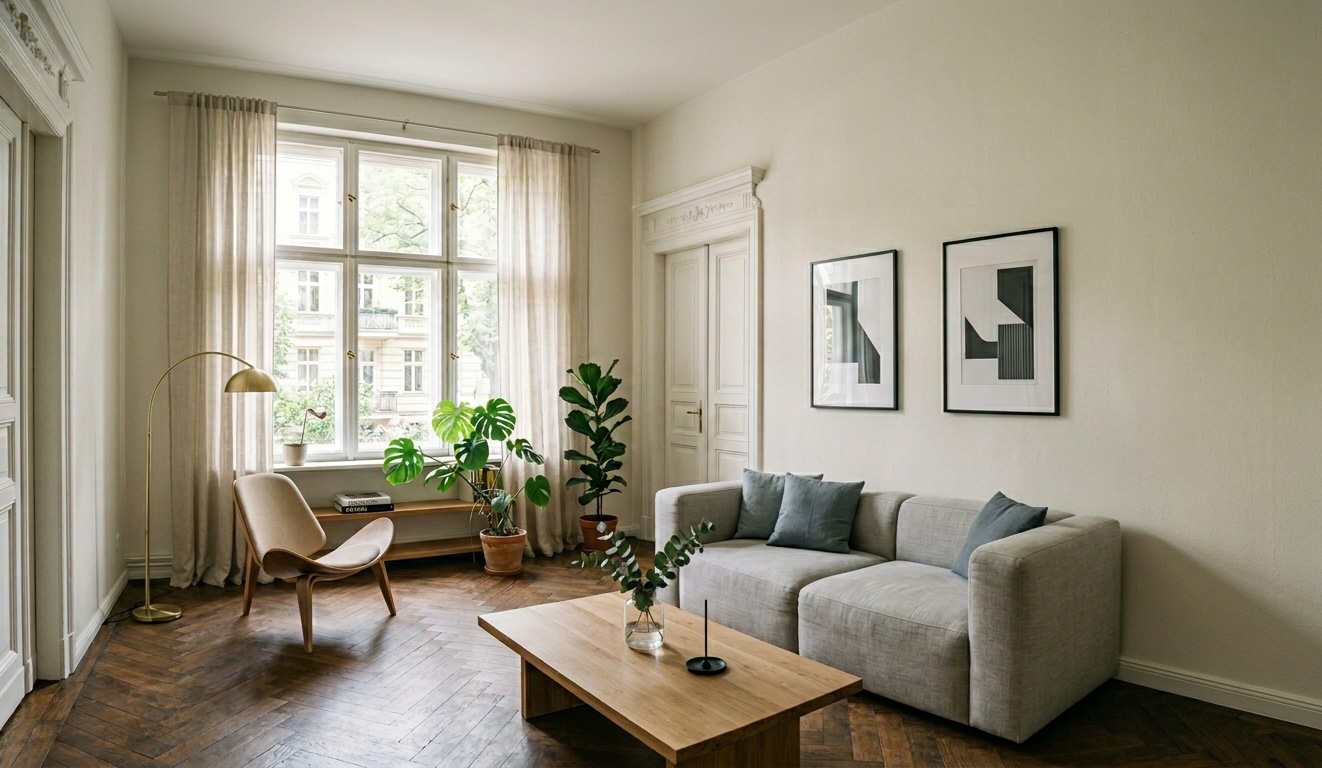
I work almost exclusively in Berlin Altbau apartments. High ceilings, deep window sills, stucco mouldings, parquet floors that quietly creak underfoot — these are not problems. They are character. And yet I see the same uncertainty in my clients again and again: how do you furnish an apartment that belongs to another era without turning it into a museum?
Here are six principles I come back to, project after project.
#1. Emphasise the vertical — don't fight it
A ceiling height of 3.2 metres is a gift. And yet I often see residents trying to "tame" that space — low furniture, pendant lights hung at mid-height, shelving that stops a metre short of the ceiling.
My approach: let the room breathe. Hang curtains from ceiling to floor — not from the window frame. Build shelves to ceiling height. Position mirrors high on the wall. The vertical is the Altbau's greatest strength; if you lean into it rather than shying away from it, the room feels intentional, not overwhelming.
A simple rule: hang every picture 10–15 cm higher than feels natural. In an Altbau, it is almost always the better choice.
The opposite challenge — an Altbau with an unusually low ceiling — came up in this project in Munich: a beauty salon inside a classic Altbau apartment. Metallic constructions and illuminated open shelving draw the eye upward and create an airy feel despite the limited ceiling height.
#2. Preserve original details — selectively
Stucco, parquet, panelled doors, old radiator niches: these are the reason people love Altbau apartments. And yet they are routinely painted over, plastered shut, or hidden behind modern built-in wardrobes.
My principle: preserve what is genuine. If the stucco is still there — restore it, don't paint it into oblivion. If the parquet is imperfect — that's fine. Worn floorboards tell a story. A freshly sanded and oiled plank looks far better than laminate trying to imitate it.
Where I do make changes: old radiators that heat poorly and occupy too much floor space. These I replace with modern vertical panel radiators. Function and character don't have to be in conflict.
#3. Take furniture proportions seriously
One of the most common mistakes in Altbau interiors: furniture scaled for a new-build apartment with 2.5-metre ceilings. In an Altbau, it looks like doll's house furniture.
Living rooms need sofas with backrests at least 85–90 cm high. Dining tables should feel generous and substantial — a delicate designer table from a chain store disappears in a 40 m² living room. Wardrobes and storage units can have real volume.
At the same time: don't overcrowd. A few well-proportioned pieces always read stronger than many small ones. In Altbau, the rule is: three good pieces over ten mediocre ones.
#4. Think about light — not just lamps
I often hear from clients: "The apartment is dark." Most of the time the issue isn't the apartment — it's the windows. North-facing orientation, deep reveals, old single-glazing.
My approach: first I analyse what natural light actually does — at which times of day, in which direction it moves. Then I decide where artificial light supplements, rather than simply replaces.
Practical steps:
- Wall colour: A warm off-white (not pure white — it reads cold in northern light) reflects light far better than darker tones
- Mirrors placed with intention: A large mirror opposite the main window effectively doubles the daylight in the room
- Multiple light sources: An uplighter, a floor lamp, and a table lamp create depth; a single ceiling fixture flattens everything
- Colour temperature: In living spaces, stay at 2700K or lower — warmer light makes a room feel considerably cosier
#5. Create zones without building walls
Berlin Altbau apartments often have large, rectangular rooms with no obvious single purpose. A living room that is also a dining room, a home office, a reading nook — it happens.
The solution: rooms within a room. A rug defines the seating area. A bookshelf — not floor-to-ceiling, but at 1.8 metres — screens the desk from the rest of the space without cutting the sightline. A different wall colour in an alcove signals: this is a distinct place.
What I avoid recommending: partition walls that destroy the room's proportions, or curtains as room dividers — they read as temporary and reduce light.
#6. Choose materials that are honest
Altbau apartments don't suit materials pretending to be something they're not. Foil-wrapped furniture imitating timber. Vinyl tiles mimicking concrete. Wallpaper printed with a brick pattern.
What works: solid wood, natural stone, linen, cotton, ceramics, oiled concrete. Materials that are allowed to age — that grow with the apartment rather than working against it.
This doesn't have to mean expensive. One good linen cushion costs less than ten synthetic ones. A solid wooden dining table found second-hand will outlast and outperform a chipboard surface with a wood-effect foil — and often at a similar price.
Every Altbau apartment is different. But the central question is always the same: what does this apartment have that no other has — and how do I make that more present, rather than less?
If you're facing that question and don't know where to begin, we'd be glad to be your starting point. The first consultation is free — you can request one here.